



- Name:
Sexy Anemone Shrimp
(View AKA's) - Family: Hippolytidae
- Species: Shrimp
- Scientific Name: Thor amboinensis
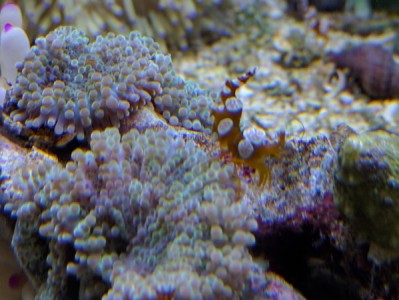
General info about Sexy Anemone Shrimp
The Sexy Anemone Shrimp is named for its unusual body movements. When walking, Thor amboinensis sways its abdomen back and forth with exotic flair. In addition to this fascinating behavior, the Sexy Anemone Shrimp is also uniquely dressed in a reddish brown body dotted with brilliant white spots. These characteristics make the Sexy Anemone Shrimps an enchanting aquarium addition. Native to the reefs of the Indo-Pacific, this member of the Hippolytidae family is usually found amongst the tentacles of an anemone. In the home aquarium, however, the Sexy Anemone Shrimp is often found perched on a coral frag or outcropping of live rock. Most are equally fearless as they are beautiful and will scavenge in any area of the aquarium in search of meaty foods. Interestingly, the Sexy Anemone Shrimp is a relatively fast grower and will molt about once a month. Although very hardy, it requires a slow acclimation process to avoid any salinity and/or pH shock. Like other invertebrates, the Sexy Anemone Shrimp cannot tolerate high nitrate or copper levels. To promote proper molting, sufficient iodine levels must be maintained.
They are also called sexy cleaner shrimp, dancing cleaner shrimp, squat anemone shrimp, squat cleaner shrimp, and the Ambon shrimp after the Indonesian island where it was first documented.
In appearance sexy shrimp are generally no larger than 3/4 inch in length, standing about 1/2 inch tall. They have a translucent brown body. Sexy shrimp sport three large white spots on their carapace and body and 5-10 spots on their tail. Sometimes these spots are outlined in a violet ring and generally, the tips of their tails are white. (Heydenreich and BÖing, 2005) Unfortunately, they have a short life span, usually less than 3-4 years.
Sexy shrimp are found in tropical marine waters from the Caribbean to the Indian Ocean and all points north and south. They are generally located in less than sixty feet of water in bays, lagoons, and backwater reefs.
The sexy shrimp's small size makes them a great choice for nano tanks, and with appropriate tank mates, they adapt to a wide variety of aquarium conditions. Sexy shrimp will hide when they feel threatened so they must be provided with rock crevices, caves, overhangs, microalgae, coral or an anemone in which to feel secure. They will thrive in a well-kept reef aquarium, at normal reef parameters: pH: 8.1-8.3 calcium 380-450 ppm, alkalinity 2.5-4.0 meq/L, nitrites <10 ppm, temperature 76-82°F. Like all shrimp as they grow, they will molt so it is important to keep your calcium, alkalinity, and pH within range.
The sexy shrimp’s tank mates should be small, calm fish such as gobies, blennies, and pygmy angels. Wrasses, seahorses, pipefish and butterfly fish should not be in the same tank since they will have a tendency to prey upon the shrimp.
Most of the time a sexy shrimp that is hosting in an anemone will be just under the oral disk rarely venturing to the surface. It’s unsure if the shrimp is using the anemone for protection from predators or if this relationship is of benefit to both species.
The sexy shrimp is often called the dancing shrimp due to its behavior when disturbed of raising its abdomen and swaying or dancing from side to side. This behavior may be to attract fish for cleaning. However, when it displays this gesture with the spines on the bottom of its abdomen erected it is clear that this is a defensive posture.
Sexy Anemone Shrimp Diet & Nutrition
Sexy shrimp are easy to feed usually taking everything from flakes to mysid shrimp. They will also feed on ciliates and detritus. They are quite popular in Europe where they are used to control ciliates such as the ones that cause brown jelly infection in Acropora coral.
Breeding & Spawning Sexy Anemone Shrimp
Sexy Shrimp do breed in home aquariums. J. C. Delbeek: “I do not have any direct experience in rearing them but suspect that they are not all that different from rearing other shrimp such as Lysmata. This means you can start them off with rotifers or newly hatched brine shrimp that have been enriched with a supplement such as Algamac (available from Argent Albs) or SuperSelco. After a few molts, the shrimp may be large enough to take larger foods such as finely ground flake food. Other foods to try offering them include Cyclopeez and Golden Pearls.”
In January 2005, European hobbyists Iris Boing and Sylvio Hydenreich published describing successful breeding in their home aquarium2. They stated that the pair began breeding shortly after they were purchased and would produce 80-150 eggs per clutch. The eggs would hatch about an hour after the lights went out. The eggs would turn a dark brown before hatching. The larvae were attracted to a small light source held to the side of the tank where they would be siphoned off to be transferred to a breeding tank. The breeding setup was a 5-gallon tank with no filtration and a 60-watt lamp kept on for 14-16 hours per day. The larvae were fed newly hatched brine shrimp that were vitamin enriched. In the breeding tank, they would continue to molt for 20- 30 days. After their final molt, they would settle down to the bottom of the tank. They reported an average of 50% success in growing out the fry. If you would like to learn more about breeding sexy shrimp check out the ProjectDIBS breeders challenge at



Original Detail
| Name | Species | Family | Scientific Name | More Detail | Added by |
|---|---|---|---|---|---|
| Sexy Anemone Shrimp | Shrimp | Hippolytidae | Thor amboinensis | The Sexy Anemone Shrimp is named for its unusual body movements. When walking, Thor amboinensis sways its abdomen back and forth with exotic flair. In addition to this fascinating behavior, the Sexy Anemone Shrimp is also uniquely dressed in a reddish brown body dotted with brilliant white spots. These characteristics make the Sexy Anemone Shrimps an enchanting aquarium addition. Native to the reefs of the Indo-Pacific, this member of the Hippolytidae family is usually found amongst the tentacles of an anemone. In the home aquarium, however, the Sexy Anemone Shrimp is often found perched on a coral frag or outcropping of live rock. Most are equally fearless as they are beautiful and will scavenge in any area of the aquarium in search of meaty foods. Interestingly, the Sexy Anemone Shrimp is a relatively fast grower and will molt about once a month. Although very hardy, it requires a slow acclimation process to avoid any salinity and/or pH shock. Like other invertebrates, the Sexy Anemone Shrimp cannot tolerate high nitrate or copper levels. To promote proper molting, sufficient iodine levels must be maintained.
They are also called sexy cleaner shrimp, dancing cleaner shrimp, squat anemone shrimp, squat cleaner shrimp, and the Ambon shrimp after the Indonesian island where it was first documented. In appearance sexy shrimp are generally no larger than 3/4 inch in length, standing about 1/2 inch tall. They have a translucent brown body. Sexy shrimp sport three large white spots on their carapace and body and 5-10 spots on their tail. Sometimes these spots are outlined in a violet ring and generally, the tips of their tails are white. (Heydenreich and BÖing, 2005) Unfortunately, they have a short life span, usually less than 3-4 years. Sexy shrimp are found in tropical marine waters from the Caribbean to the Indian Ocean and all points north and south. They are generally located in less than sixty feet of water in bays, lagoons, and backwater reefs. The sexy shrimp’s tank mates should be small, calm fish such as gobies, blennies, and pygmy angels. Wrasses, seahorses, pipefish and butterfly fish should not be in the same tank since they will have a tendency to prey upon the shrimp. Most of the time a sexy shrimp that is hosting in an anemone will be just under the oral disk rarely venturing to the surface. It’s unsure if the shrimp is using the anemone for protection from predators or if this relationship is of benefit to both species. The sexy shrimp is often called the dancing shrimp due to its behavior when disturbed of raising its abdomen and swaying or dancing from side to side. This behavior may be to attract fish for cleaning. However, when it displays this gesture with the spines on the bottom of its abdomen erected it is clear that this is a defensive posture. |
PalaciosAn |